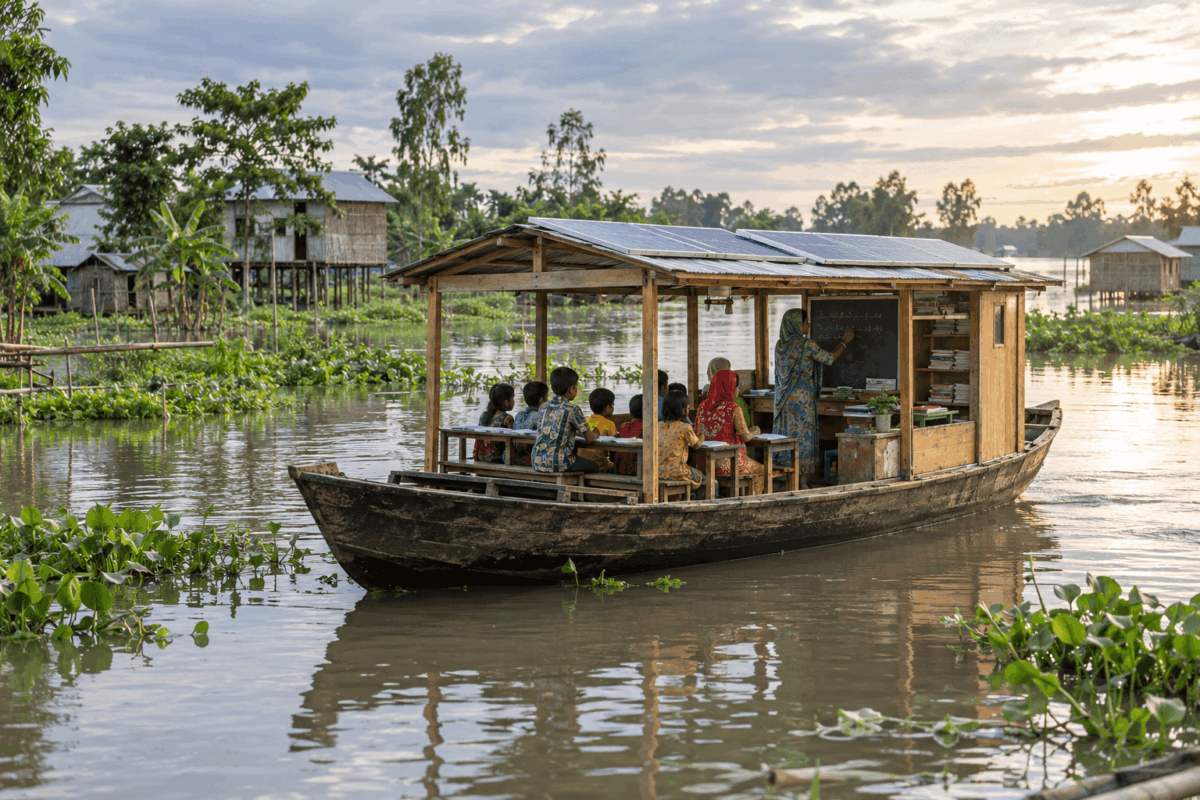
Every morning in the wetlands of north-west Bangladesh, a wooden boat with a solar-panelled roof slips along a flooded channel and pulls up at the edge of a village. Children climb aboard with their books. The boat moves on to the next village, and the next, until its benches are full. Then it moors, a teacher picks up the chalk, and the lesson begins.
For many of those children, this boat is the only reason they are in school at all. In the monsoon season, roads and paths around the Chalan Beel wetland disappear under water for months at a time. Land-based schools can be cut off or flooded, and a child’s education can quietly stop.
The boats exist because one person decided that wasn’t acceptable. It’s a story about access, imagination and refusing to treat a barrier as the end of the conversation, and it makes a good one for the staff room.
A problem he knew first-hand
Mohammed Rezwan grew up in Natore district, in the same flood-prone region his organisation now serves. Speaking to the BBC, he described seeing friends and relatives drop out of school because the paths they needed simply weren’t there during the monsoon. “It was difficult for me to accept the situation,” he said.
He went on to study architecture, and at first he imagined building schools and clinics. But he realised that anything he built on the land risked ending up under water. So he turned the question around. In his words, if the children couldn’t come to the school, the school should come to them, by boat.
Five hundred dollars and an old computer
In 1998, while still a student, Rezwan founded a non-profit called Shidhulai Swanirvar Sangstha. Shidhulai is the name of a village in Natore, and swanirvar sangstha means “self-reliant organisation”. He started it with around US$500 of his own scholarship money and savings, a detail reported both by the organisation and by Reuters.
According to the organisation’s own account, he had an old computer and no experience of writing funding bids, so he taught himself, sending proposals to hundreds of potential supporters. It took four years to raise enough to build the first school boat, which launched in 2002.
A school bus and a schoolhouse in one
The design is clever in its simplicity. The boats are built by local boatbuilders using local timber and traditional techniques, then adapted with waterproof roofs, flexible floors and solar panels. Each school boat has room for a class of around 30 children, with benches, a blackboard, bookshelves and, on many boats, a laptop or computer powered by the sun.
Each boat works as both school bus and classroom. It collects pupils from several riverside stops, then holds lessons once the last children are aboard. Classes run in shifts, three a day, six days a week, so one boat can teach several groups. Solar power has a bonus too. Because the boats have light, they can run lessons later in the day for children who have to work.
The organisation also gives families solar lanterns, so children can keep studying at home after dark. In a region where many homes have no reliable electricity, that small light extends the school day well beyond the boat.
From one boat to a fleet
The idea grew quickly. In 2005, the Bill & Melinda Gates Foundation gave Shidhulai its Access to Learning Award, worth US$1 million, for using traditional boats to bring libraries, schools and internet access to remote communities. The foundation noted that more than 70 per cent of the programme’s beneficiaries were women and girls.
Over the following years the fleet expanded to include library boats, training boats for farmers, health clinics and even floating playgrounds. Reports of the fleet’s size vary depending on what is counted. UNESCO lists 56 year-round boats, 26 of them classrooms, and other accounts mention more than 100 when seasonal boats are included. During severe floods, some boats double as shelters for families who have lost their homes.
In 2025, the floating schools received the UNESCO Confucius Prize for Literacy, one of the international literacy prizes UNESCO has awarded since 1967. UNESCO describes the programme as reaching more than 800,000 learners in flood-prone areas, counting adults in its training and library work as well as children. A senior manager told Reuters that over 22,500 pupils have graduated from the boat schools so far.
Built with the community, not for it
What stands out in Rezwan’s own words is how little of this is really about the boats. When UNESCO honoured the programme, he said: “Our advice is to prioritize people over machines. Technology only works when it is rooted in the lives of learners.” The boats are designed with local input and staffed by community members, including women and former students.
He also noticed early on that girls and women were the most isolated when the water rose, so the programme put particular effort into making learning safe and comfortable for them and their families.
Why this story matters to us
Few of us will ever teach on a boat. But every school has children for whom getting to the learning is the hardest part, whether the barrier is distance, illness, a caring role at home, anxiety or a timetable that doesn’t fit their lives. Rezwan’s question is one any teacher can ask: if this child can’t reach the lesson, how can the lesson reach this child?
It’s also a reminder that powerful solutions often come from using what is already around us. Rezwan didn’t invent a new kind of vessel. He took the boats his community had always used and gave them a new purpose.
What we can take into our classroom
- Ask the Rezwan question. For a pupil who keeps missing out, flip the problem: instead of “Why isn’t this child getting to the learning?”, ask “How could the learning get to this child?”
- Plan for disruption before it happens. Floods are predictable in Bangladesh, and so are many of our disruptions, from snow days to long absences. A ready-made pack or online space keeps learning moving.
- Let learning travel home. The solar lanterns kept the school day going after dark. Book bags, story sacks, audio recordings or a class lending library can do something similar.
- Use what you already have. Look around your school and community for the “boats”: spaces, people and resources you can repurpose before buying something new.
- Design with families, not just for them. Rezwan’s boats were shaped by local voices. A quick parent survey or pupil voice session can reveal barriers you might never spot.
- Bring the real world in. Floating schools are a brilliant hook for geography, design technology and climate lessons. Challenge pupils to design a classroom for a community facing floods.
Sources
- BBC News – In pictures: Solar-powered floating schools
- Reuters – In Bangladesh’s flooded plains, schools in boats keep learning afloat (October 2025)
- Reuters (Thomson Reuters Foundation) – Boat schools bring classroom to Bangladesh’s flood-hit children (2015)
- Bill & Melinda Gates Foundation – 2005 Access to Learning Award press release
- CLIR – Shidhulai Swanirvar Sangstha: Bringing Information Technology to Rural Bangladesh by Boat
- UNESCO – UNESCO Confucius Prizes 2025: Transforming lives through literacy in Bangladesh, Ireland and Morocco
- UNESCO – Bangladesh’s Sidhulai Swanirvar Sangstha receives UNESCO Confucius Literacy Prize 2025
- Equator Initiative (UNDP) – Shidhulai Swanirvar Sangstha case study
- Shidhulai Swanirvar Sangstha – About us
Categorised in: Ibbleobble
This post was written by kidd78