In the spring of 1982, eighteen teenagers from a struggling high school in East Los Angeles sat one of the hardest exams an American school pupil can take: the Advanced Placement (AP) calculus test, a college-level paper that only a small fraction of US students ever attempt. All eighteen passed. A few months later, they were told that most of their results were under suspicion.
What happened next made a film, a national name and a lasting lesson for every teacher who has ever been told that “our pupils can’t do that”. This is the story of Jaime Escalante and the calculus class at Garfield High School.
A teacher who started again from scratch
Jaime Escalante was born in La Paz, Bolivia, on the last day of 1930, the son of two schoolteachers. He followed them into the profession and built a strong reputation teaching maths and physics in Bolivia before moving to the United States in the 1960s.
There was a catch. His Bolivian teaching qualification wasn’t recognised in California, so he couldn’t teach. He mopped floors and then cooked in a Pasadena restaurant, before becoming an electronics technician at the Burroughs Corporation, studying at night all the while. He earned a new mathematics degree from California State University, Los Angeles, and then a US teaching credential. In 1974, now in his forties, he walked into Garfield High School as a basic maths teacher.
Low expectations, high ambitions
Garfield served a hard-pressed, largely Mexican-American community in East Los Angeles. The Los Angeles Times reported in 1988 that at least 80% of its students qualified for free or reduced-price lunches. Escalante was dismayed by how little the school expected of its pupils. Many were being steered towards basic arithmetic, with little route into algebra, let alone calculus.
He decided to change the ladder rather than the children. With the backing of a new principal, Henry Gradillas, and alongside fellow maths teacher Ben Jiménez, he began building a pathway: proper algebra first, then the courses that lead up to calculus. In the autumn of 1978 he launched his first AP calculus class. According to the journalist Jay Mathews, who wrote a book about Escalante, fourteen pupils signed up and only five lasted until the exam. Their results were mixed.
He didn’t give up. Year by year, more pupils took the course and more of them passed.
How the classroom worked
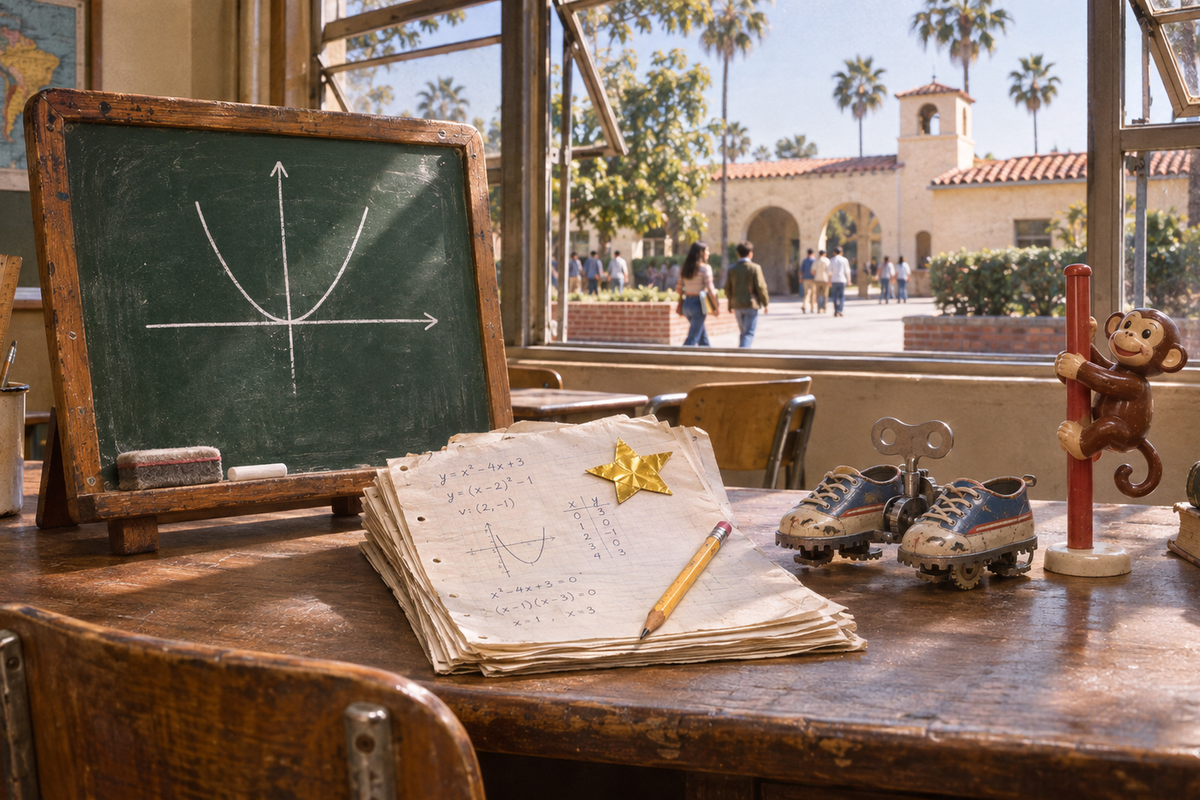
Escalante’s lessons were demanding, but they were also tremendous fun. He used humour, theatre and props. A wind-up toy pair of walking shoes reminded pupils to work step by step; a little plastic monkey climbing a pole illustrated inverse functions. A poster on his wall, Mathews reported, read: “Calculus need not be made easy; it is easy already.”
Underneath the showmanship was a tight structure. Mathews described the routine Escalante set out on the first day: doors open at 7am, an early start, notes kept in a folder, a short quiz every morning and a test every Friday. Pupils, and their parents, signed a contract promising attendance, homework and effort, and Escalante signed it too, pledging to bring what he called ganas, a Spanish word for desire or drive, to every lesson. He didn’t select pupils by ability. What he asked for was ganas.
Later, with support from local businesses and foundations, he added Saturday sessions and an intensive summer programme at East Los Angeles College, so pupils could catch up or get ahead.
The class that had to pass twice
In 1982 all eighteen of his calculus pupils passed the AP exam, and the New York Times reported that seven earned the top grade of 5. The Educational Testing Service, which administered the exam, noticed similarities between some of the papers and challenged fourteen of the results.
The pupils were offered several options, one of which was to sit the exam again. Twelve of them did, with very little time to prepare and under strict exam conditions. All twelve passed again, and their original results stood.
The episode was painful, but it put Garfield on the map. In 1988 the film Stand and Deliver, starring Edward James Olmos as Escalante, told the story to the world. Escalante himself was careful to point out that the film made it look like an overnight miracle. In reality, he said, getting his pupils to understand calculus had been a long, tough road.
What the numbers became
The real achievement is what came after. By 1987, according to Mathews, 129 Garfield pupils sat the AP calculus exam, and around two-thirds passed. Only a handful of public schools in the entire country entered more pupils for the paper. The school’s wider AP programme grew alongside it, as other departments raised their own expectations.
Escalante received the Presidential Medal for Excellence in Education and, in 1999, was inducted into the US National Teachers Hall of Fame. He later taught in Sacramento, and he presented an award-winning educational TV series about careers that use maths and science. He died in 2010, aged 79.
What we can take into our classroom
- Build the ladder, not just the top rung. Garfield’s success came from years of work on the courses leading up to calculus, not from one brilliant class. Look at what pupils need two or three years before the “big” goal.
- Make the structure visible. A daily quiz, a weekly test and a folder of notes gave pupils a rhythm they could rely on. Small, frequent checks help pupils, and us, see progress.
- Bring parents in early. A simple shared agreement between pupil, parent and teacher sets out what everyone is promising.
- Use humour and props. A toy or a silly image can make an abstract idea stick far better than another worked example.
- Open the door wide. Escalante asked for effort, not a track record. Invite pupils who might never put themselves forward.
- Play the long game. His first exam class was small and the results were mixed. Keep going.
Jaime Escalante didn’t find exceptional pupils at Garfield. He built a classroom where ordinary teenagers could do something exceptional, and then he kept proving it, year after year.
Sources
- Los Angeles Times (1988): The Escalante Equation, by Jay Mathews
- Los Angeles Times (2010): Jaime Escalante dies at 79
- New York Times (2010): Jaime Escalante, Inspiration for a Movie, Dies at 79 (PDF copy)
- Washington Post (1982): Dedicated Calif. Teacher Turns Students Into Calculus Whizzes
- MacTutor History of Mathematics, University of St Andrews: Jaime Escalante
- National Teachers Hall of Fame: Jaime Escalante
- The Futures Channel: The Jaime Escalante Math Program
- Education Week (1994): Jaime Escalante’s Second Act
Categorised in: Ibbleobble
This post was written by kidd78