It began with a throwaway remark. In February 2012, a long-standing volunteer at St Ninians Primary School in Stirling watched a class struggle through a warm-up and turned to the headteacher, Elaine Wyllie. The children, he told her, were not fit.
She already had a nagging feeling he was right. The school’s PE teacher said the same thing: many pupils were exhausted by the warm-up alone. So Elaine decided to find out for herself. What happened next started with one Primary 6 class and a muddy path round a football pitch, and grew into one of the most widely copied school ideas of the past decade: The Daily Mile.
One class, one field, one afternoon
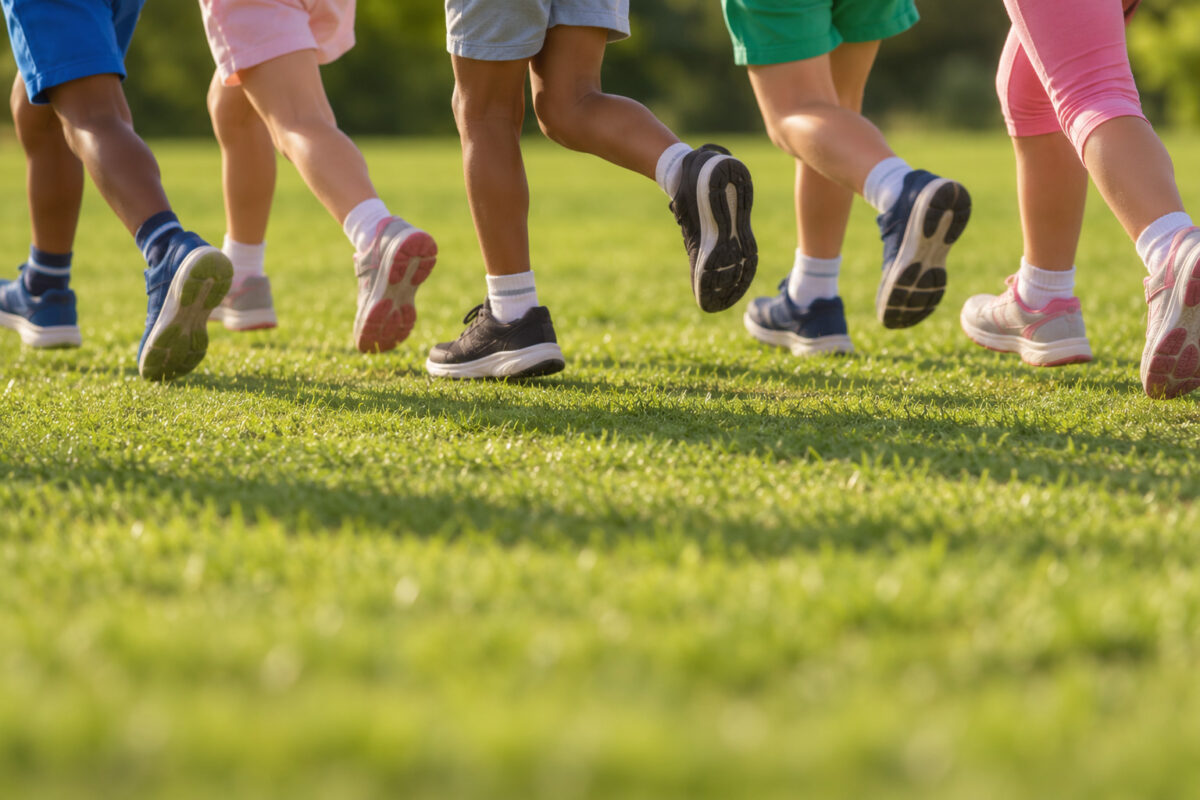
The next day, Elaine was covering that same Primary 6 class while their teacher was away. She took the children outside and asked them to run round the path that borders the school field, to see how far they could get.
Most of them didn’t get far. By her own account, many were doubled over with a stitch before they had reached the far end, and some could only manage a single lap. Back in the classroom, she asked how it had gone. The children’s verdict was simple: it had been terrible.
Rather than leave it there, Elaine sat down with the class and their teacher, and together they agreed a plan. The class would go out and run round the field every day for a month, and see what happened.
From one class to the whole school
By the end of the month, almost all of the children could get round the field without stopping. Curious about how far they were actually going, the class got out a trundle wheel and measured the path. Five laps came to roughly a mile. The Daily Mile had its name.
Other teachers noticed. By Easter, Elaine told The Times, five classes had joined in. By the summer it was every class in the school, and the nursery followed soon after. At its height, she said, all of the school’s roughly 420 children, aged three to 12, were going out every day.
Parents noticed too. Elaine has described children who were more alert in class, more settled after break, and sleeping better at night. When the school nurse came to weigh and measure the youngest pupils, she reportedly came running in to say she had never seen results like it.
Why it worked: keep it simple
What makes The Daily Mile so easy to copy is how little it asks of a school. Elaine has always been clear about a few ground rules.
- No changing. Children go out in their school uniform and whatever shoes they are wearing. As Elaine told The Times, you have no idea how long it takes a Primary 6 class to get changed.
- Fifteen minutes, at their own pace. Children run, jog or walk. Nobody is timed, nobody is picked last and nobody sits out because they’re not sporty. Elaine has said that pupils with mobility difficulties still take part.
- Out in (nearly) all weathers. Only heavy rain or ice underfoot stops it. Children, she says, rather like the wind and the odd snowflake on their faces.
- No kit, no cost. There’s no equipment, no special training and no new timetable slot.
It is also sociable. Elaine has said the conversations on the track are different from those in the classroom. Children encourage each other, run in pairs and chat to their teachers in a way they might not do indoors.
Does it really make a difference?
In 2018, researchers from the universities of Stirling and Edinburgh published a study in the journal BMC Medicine. They compared two primary schools in the Stirling area, one that introduced The Daily Mile and one that didn’t, and tracked almost 400 children aged four to 12 over a school year. Pupils at The Daily Mile school became more active, spent less time sitting still, ran further in a shuttle-run fitness test and showed a small reduction in body fat compared with the other school. The University of Stirling summarised the gains as roughly 15% more physical activity and 5% better fitness. The authors were careful to call it a pilot study.
A second Stirling-led project, run with the BBC and involving thousands of primary pupils across the UK, found that children did best in short memory and attention tests after exercise at their own pace, rather than after a flat-out fitness test.
The evidence isn’t all one way, and that’s worth knowing. A later study reported by the BBC in 2022 found that while taking part for more than three months was linked with better fitness, it found no lasting benefit for thinking skills or wellbeing. The fair summary is that The Daily Mile reliably makes children fitter, and many teachers say it helps them settle, but it isn’t a magic switch for attainment.
A Stirling idea that went global
What started on one school field didn’t stay there. Elaine retired from teaching in 2015 after 38 years and devoted herself to spreading the idea. That same year she was named Teacher of the Year at the Pride of Britain Awards. The Daily Mile Foundation was set up in 2016 to support schools that wanted to take part.
When The Daily Mile turned ten in 2022, the BBC reported that around three million children at 14,000 primary schools were taking part. The Foundation now says that more than 20,000 schools and nurseries in more than 90 countries have joined, and more than five million children. In 2024 Elaine received a Lifetime Achievement award at the Pride of Scotland Awards.
What we can take into our classroom
You don’t need to sign up to anything to borrow the thinking behind The Daily Mile:
- Try it for a month. Elaine’s original plan was a four-week experiment with one class. A short, low-stakes trial is an easy way to see what works for your pupils.
- Let children measure their progress. The trundle wheel moment turned fitness into maths. Laps, distances and personal bests make great real-life data for graphs and estimation.
- Make it for everyone. Running, jogging and walking all count. When no one is ranked, the least confident children are often the ones who gain most.
- Use movement as a reset. A short burst outside before a demanding lesson can help a restless class come back ready to focus.
- Listen on the move. Side-by-side conversations outdoors can open doors that a desk never does. It’s a good moment to check in with a quiet child.
- Keep the barriers low. No changing, no kit, no fuss. The simpler a routine is, the more likely it is to last beyond the first enthusiastic week.
A final thought
Elaine Wyllie didn’t set out to start a worldwide movement. She noticed something was wrong, asked a class to help her try something about it, and kept going when it worked. Sometimes the most powerful ideas in education really are the simplest ones, and they can start with a single lap of the school field.
Sources
- The Herald – Daily Mile pioneer Elaine Wyllie: initiative can improve everything from fitness to numeracy
- The Times – Elaine Wyllie: why the daily mile matters
- Pride of Britain – Elaine Wyllie, Teacher of the Year 2015
- BMC Medicine – Chesham et al. (2018), The Daily Mile makes primary school children more active, less sedentary and improves their fitness and body composition
- University of Stirling – The Daily Mile research spotlight
- BBC News – Ten years of the Daily Mile celebrated worldwide (2022)
- Pride of Scotland Awards – Lifetime Achievement 2024: Elaine Wyllie
- The Daily Mile Foundation – Our history
- Education Scotland – The Daily Mile factsheet for schools
Categorised in: Ibbleobble
This post was written by kidd78