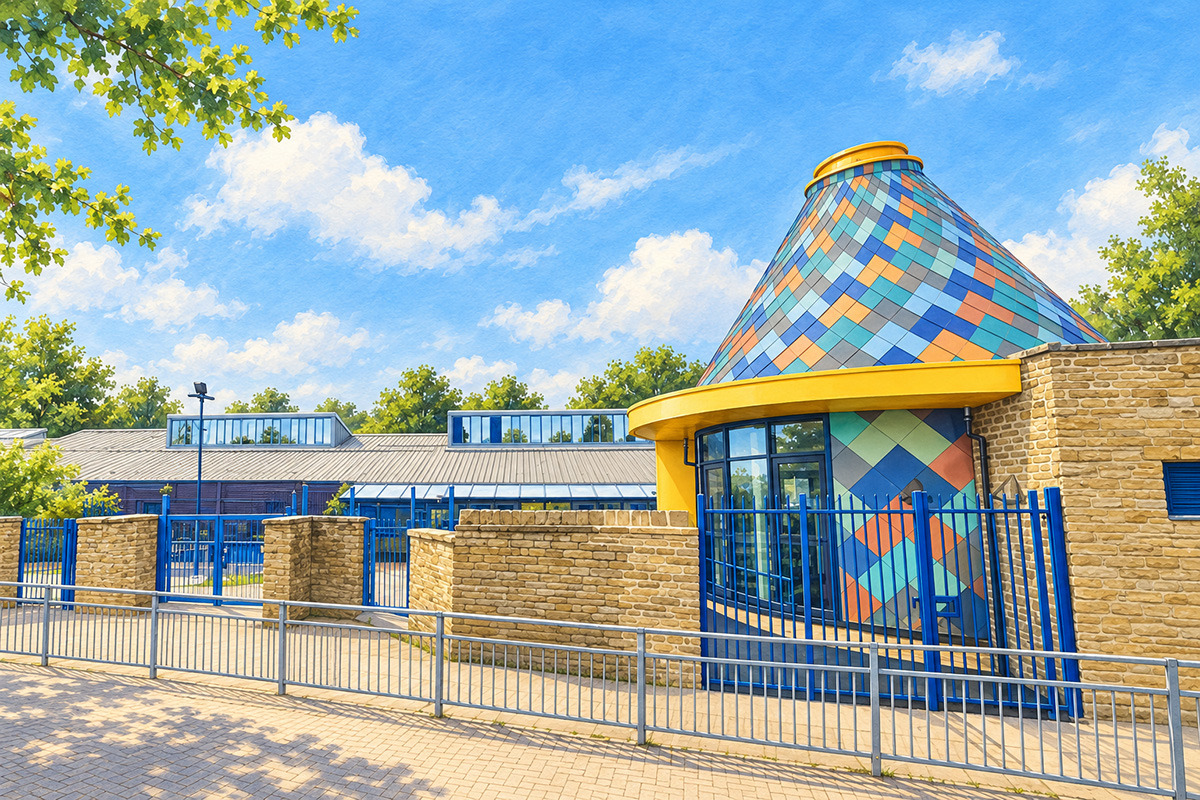
Walk past Feversham Primary Academy in Bradford on a school day and you may well hear it before you see it. Singing drifts out of classrooms and clapping games echo round the playground.
It wasn’t always like this. In the early 2010s, Feversham was in special measures. Results were poor, behaviour was a serious problem and, by the school’s own account, parents had switched off. Today it is rated Outstanding by Ofsted, and its pupils have made some of the strongest progress in reading and maths in England.
What changed? Instead of piling on extra English and maths, the school put music at the heart of every school day. It’s a story worth sharing in any staff room.
A school with everything to prove
Feversham sits in Bradford Moor, one of the city’s most deprived and densely populated neighbourhoods. Almost every pupil speaks English as an additional language: the BBC put the figure at more than 98%, and the Guardian at 99%. Around 30 languages are spoken in the school, and many children arrive in the early years with little or no English.
Naveed Idrees became headteacher in 2013, not long after the school had become an academy. He has been frank about where it stood. Speaking to the BBC, he described children who were disengaged, a curriculum that didn’t inspire them, and behaviour that was a major issue. “We deserved to be where we were,” he said.
The obvious response for a school in that position would be more booster classes and more test practice. Idrees has said the school could have gone down that road, and might even have hit its targets, but at the cost of staff morale and children’s love of learning. “We want kids to enjoy learning,” he told the Guardian. He admits what the school did instead was a big risk.
Enter Mr Rotheram
The school’s gamble rested largely on one teacher. Jimmy Rotheram had taught music in secondary schools and colleges, left teaching to try to make a living as a musician, then returned as a primary supply teacher, including at Feversham. He found that younger children’s natural enthusiasm reignited his own passion for teaching.
Feversham created a brand-new, full-time role for him as music coordinator. At the same time it appointed specialists in drama, science and design technology. But both the headteacher and Ofsted inspectors have singled out music as the spark for what followed.
Rotheram built the programme largely on the Kodály approach, named after the Hungarian composer Zoltán Kodály. It is based mainly on singing, rhythm, movement and hand signs, so it needs no expensive instruments. Rotheram trained in the method in his own time, at weekends and in the holidays.
His golden rule, as he told the BBC, is that music “should always be a joy, never a torture”. Lessons for the youngest children have a party atmosphere, with pupils dashing round the room as he directs from the piano.
Music in every corner of the day
What makes Feversham unusual is how much music there is, and how far it spreads. Every child gets at least two hours a week, the Guardian reported: a lesson, a follow-up lesson and a weekly music assembly with a guest musician and group singing. With choirs and clubs, many pupils do far more. The figure is often quoted as up to six hours a week, and Rotheram told the BBC that some pupils were doing as many as eight.
Songs also turn up in other lessons, so pupils might sing their times tables or a piece of history. Older children act as playground leaders and run the singing games they’ve learned in class with the younger ones.
Bringing families along
Not everyone was convinced at first. Many Feversham families are Muslim, and some parents had concerns about some of the music their children would be learning. Rotheram remembers early concerts where only one or two parents came.
The school’s response was to listen, and to widen the repertoire. Alongside Shakespeare and the Beatles, pupils learned nasheeds, Islamic songs, and folk songs from around the world. The school invited Muslim musicians in, including the Sheffield-born nasheed singer Ahmad Hussain, to show children that faith and music could sit comfortably together. By 2017, the Guardian reported, the end-of-year concert was selling out every year.
The results
The academic turnaround has been striking. In 2017, 74% of Feversham pupils reached the expected standard in reading, writing and maths, against a national average of 53%. By 2018 the BBC reported that, according to official performance tables, the school was in the top 10% in England for pupil progress in core subjects. For its oldest pupils, progress in reading and maths was in the top 2% and top 1% respectively.
In April 2019, Ofsted rated Feversham Outstanding in every area. Inspectors wrote that its curriculum, “with music and drama at its core”, made a significant contribution to pupils’ positive attitudes and outcomes. When inspectors returned in June 2025, music was one of four subjects they looked at in depth, and the school was again judged Outstanding in every category. The report calls Feversham “an oasis of joy and hope”.
Some of the most moving stories are about individual children. The Guardian met Abiha, who joined the after-school clubs as a young child and went on to become the first Muslim girl to pass the audition for Bradford’s gifted and talented music programme for primary pupils. The BBC filmed Adyan, a reception-age boy who had arrived with very little English, singing the alphabet as he played the piano, while his mother said music was helping to unlock his communication.
To be fair, as the BBC pointed out, no study has proved that music directly raises academic results, and a school’s fortunes usually change for many reasons at once. Feversham brought in other specialists too. But the people who know the school best, from its headteacher to Ofsted’s inspectors, see music as central to the change.
What we can take into our classroom
You don’t need a full-time music coordinator to borrow Feversham’s thinking:
- Make joy non-negotiable. Rotheram’s “joy, never a torture” rule works for any subject. Children who enjoy learning come back for more.
- Sing the tricky stuff. Times tables, spellings, the order of the planets: a simple tune or chant can make knowledge stick, and it costs nothing.
- Start with your voice and body. Clapping games, call-and-response and body percussion need no instruments and suit every key stage.
- Use music for routines. A tidy-up song or a sung signal to stand or sit down can calm a classroom and support children who are still learning English.
- Bring families in. Concerts, sharing assemblies and music that reflects pupils’ own cultures can turn sceptical parents into supporters.
- Let children lead. Older pupils teaching games to younger ones builds confidence on both sides, and spreads the learning across the whole school.
A final thought
When a school is struggling, the brave choice isn’t always to narrow the day. Sometimes it’s to fill it with things children love, and trust that the learning will follow. In one corner of Bradford, it has.
Sources
- The Guardian – How to improve the school results: not extra maths but music, loads of it (October 2017)
- BBC News – How a school in Bradford is beating the odds with music (September 2018)
- Ofsted – Feversham Primary Academy inspection report, April 2019
- Ofsted – Inspection of Feversham Primary Academy, June 2025
- Teachwire – How to fit 6 hours of music into the primary curriculum – a week! (Jimmy Rotheram)
- Royal Philharmonic Society – How music can transform a school
- Researching the Arts in Primary Schools – How the Arts have transformed Feversham Primary (January 2022)
- Lift Feversham – Music specialists
Categorised in: Ibbleobble Positive Vibes
This post was written by ibbleobble_paul